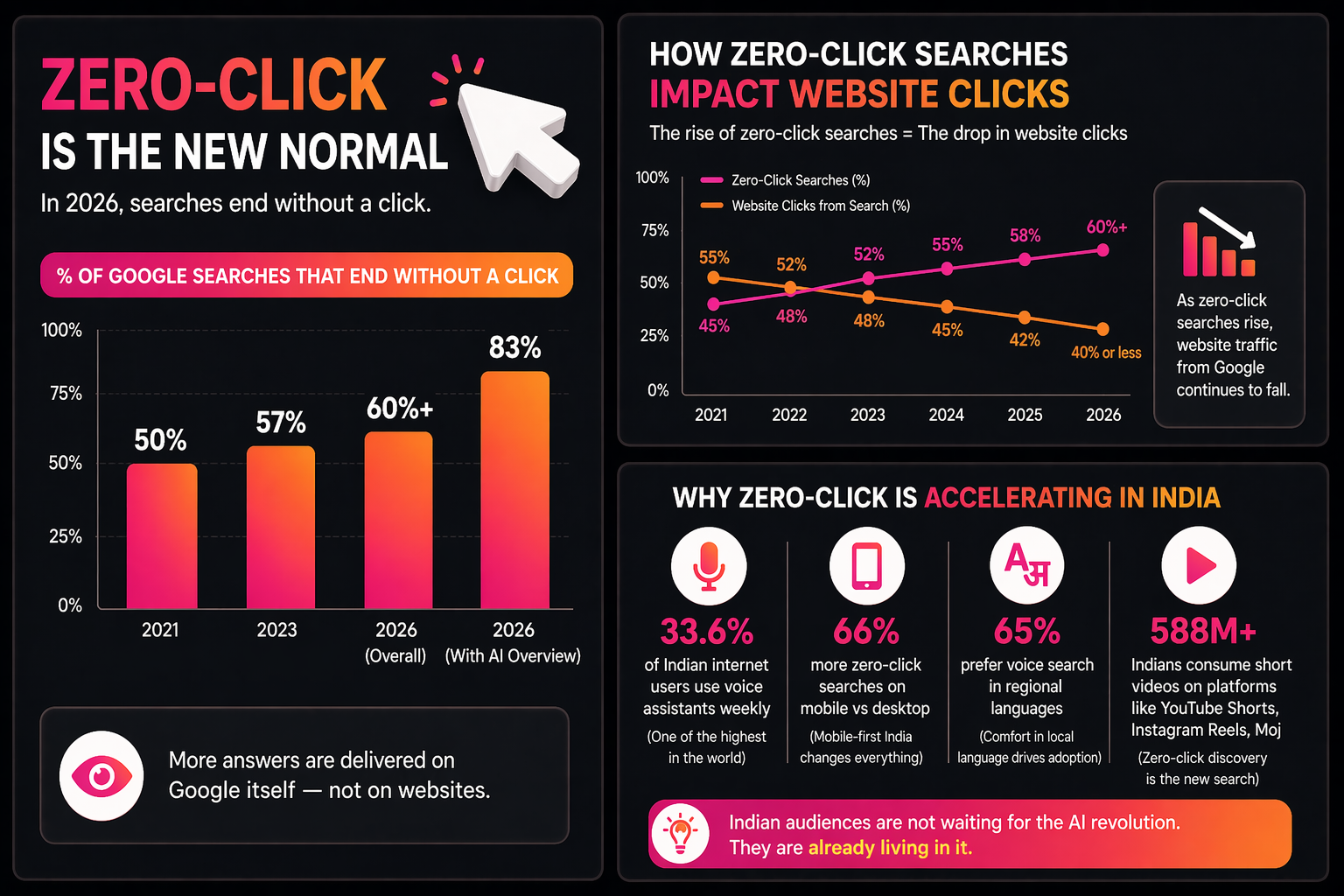
The data every startup founder should be attentive to is that more than 60% of Google searches in 2026 end without a single click to any website.
Not 10% or 20%. More than half of everyone who searches for anything on Google gets their answer instantly and moves on, without ever visiting your website, your blog or landing page.
And if you think that’s alarming, searches that trigger Google’s AI overview have an 83% zero-click rate. That means 8 out of 10 users get their answer straight from the search results page and never go further.
For startups or businesses that have poured time and money into content marketing, blog writing, and SEO, this may feel off, but here is the counterintuitive truth most startups are missing: the zero-click era is not the death of visibility. It is a different kind of visibility, and for authentic startups, it is actually an opportunity.
This blog is your comprehensive guide to understanding zero-click marketing, why it matters more in India’s rapidly evolving digital landscape, and the exact strategies your startup can implement to build trust, authority and brand recall, even without the click.
What Is Zero-Click Marketing and Why It Matters in 2026
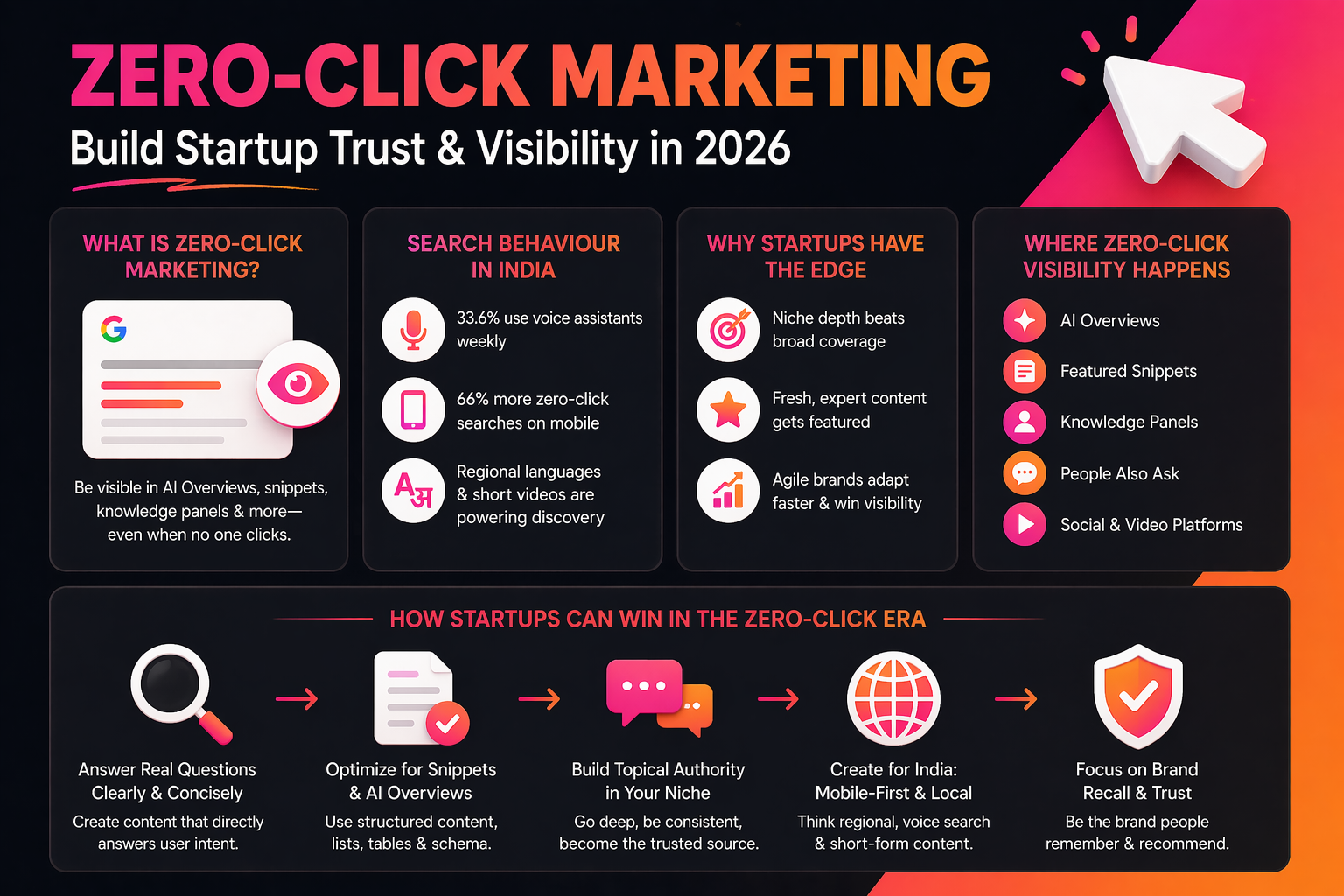
Zero-click marketing is a brand strategy where businesses stop relying on people clicking on their website and find answers in Google’s info boxes as an intentional effort to show up in AI overviews, featured snippets, Google knowledge panels, social feed, podcasts and AI tools, as the trusted, recognisable name in your space, even when no one is clicking through.
Zero-click search is what happens on SERP (Search Engine Results Page). Zero-click marketing is how smart brands respond to it strategically.
The mechanism is simple: Google no longer sees itself as a gateway to the information. It sees itself as the destination. And it is delivering on that vision through featured snippets that summarise your website or blog information. AI overview that compiles answers from various sources, knowledge panels that tell your brand’s story without a click, and People Also Ask boxes that keep users engaged inside Google’s ecosystem.
For brands that obsess over website traffic as the primary metric, this is indeed a crisis. But for brands that think in terms of awareness, trust, and authority, it’s a new frontier.
How Search Behaviour Has Shifted for Indian Startup Audiences
India has already seen a surge in the zero-click shift, which is happening on top of a foundation that is uniquely different from Western markets, and that makes both the challenge and opportunity far more interesting.
As of 2025, India crossed 958 million active internet users, with rural India now accounting for 57% of that base and growing nearly four times faster than urban areas (IAMAI/Kantar Internet in India Report 2025). That's close to one billion people who are just beginning to shape their digital habits, and the majority of them are not typing queries into a laptop. They're speaking into a smartphone.
Voice search is now common in India. According to industry data, approximately 33.6% of Indian internet users use voice assistants weekly, one of the highest rates in the world. Industry experts estimate that nearly 65% of Indian users prefer voice search due to its ease of use in multilingual environments, particularly in Tier-2 and Tier-3 cities where regional language comfort is stronger than English typing fluency.
And voice search is inherently zero-click. When you ask Google Assistant or Siri a question in any language, you get a spoken answer, not a list of blue links, and your website doesn’t even enter the picture.
Add to this the fact that 44% of Indian internet users are now actively using AI-enabled features like voice search, image-based search, and chatbots (IAMAI, 2025), and it becomes clear: the Indian startup audience is not waiting for the AI search revolution. They're already living it.
For Indian startups, this is important:
Mobile-first is non-negotiable - Mobile users are 66% more likely to experience zero-click searches than desktop users. If your brand isn’t optimised for the mobile SERP experience, you are invisible to the majority of your market.
Regional language content is a competitive moat - Most of the startups ignore regional languages in their content strategy. In a zero-click world where featured snippets and AI overviews draw from indexed content, being the only authoritative source in a regional language for your niche gives you disproportionate visibility.
Short videos and social discovery are your real search engine - In 2025, the short video content consumed by 588 million Indians on platforms like YouTube Shorts, Instagram Reels, and Moj are themselves becoming search and discovery engines, and all are zero-click by nature.
Why Startups Actually Have an Edge in Zero-Click Marketing
This might surprise you, but zero-click marketing disproportionately rewards challengers over incumbents. That’s a game startups can genuinely win.
Here’s what actually changed. In traditional search, visibility was heavily reliant on domain age, backlink volume, and content scale. But zero-click operates on a different logic; it reduces the traffic advantage that high-authority players have enjoyed for years.
If 60% of searches don’t result in clicks anyway, the gap between your domain and a competitor with 10x your backlinks matters less. What matters more is whether AI systems consider your content citation-worthy, and that’s determined by content quality, structure, and authority signals that startups can build from day one.
That’s a fundamental levelling of the field now.
Niche depth beats broad coverage - Search engines’ AI overviews do not always show the most well-known brand; they show the clearest, most structured answer to a specific question. A startup that owns a narrow topic deeply and communicates it simply can earn that position.
Founder-led content is a real signal - When a startup founder writes about a problem they are actively solving, that content carries first-hand experience, an exceptional perspective, and specificity that is genuinely difficult to replicate at scale.
Google’s E-E-A-T framework rewards this kind of real-world, lived-experience content, such as a 500-word post written by someone who has actually done the things, often outperforms a polished, committee-approved piece on the same topic.
Being cited matters more than ranking first - Brands cited in AI responses see a 38% increase in organic clicks, meaning the quality of your citation directly builds downstream traffic and trust. For a startup, gaining one well-placed citation in an AI Overview for a relevant query can deliver brand impressions that a paid campaign would struggle to match.
Community closeness is an underrated asset - Community engagement is a must nowadays because building relationships in social media and niche communities creates a presence that AI cannot easily disintermediate. That presence feeds the brand signal that the zero-click system rewards.
The opportunity, in simple terms: zero-click marketing is one of the few places in digital marketing where a startup with genuine expertise, a clear voice, and consistent helpfulness can out-position a much larger player, not by outspending, but by out-specifically them.
6 Zero-Click Marketing Strategies Startups Can Use Right Now
1. Optimise for Featured Snippets and AI Overviews
Featured snippets are those highlighted answer boxes at the top of a search engine’s results, the original zero-click thing. That is one of the most direct paths for a startup to build authority on an affordable budget.
The formula for earning a featured snippet is well-established - answer a specific question clearly, concisely and in a structured format. If we see, Google typically extracts answers of 40-60 words. That means your content needs a clear question as a heading (H2 or H3), followed immediately by a direct answer. Then expand with context, examples, and supporting details.
For AI Overviews specifically, the rules are similar, but the stakes are higher. AI-generated summaries pull from multiple sources and create a synthesised answer.
For Indian startups, there is a specific opportunity here - most of the competitive information queries in English and other languages have few optimised answers. Being the one to publish a well-structured, clearly formatted answer to a common business or consumer question in their regional language can earn you a featured snippet with almost no competition.
Actionable steps:
Use Google's "People Also Ask" boxes to identify question-based queries in your niche
Structure every important page with a question heading followed by a 40–60 word answer
Add FAQ schema markup to your key pages
Refresh your top-performing content every quarter for freshness to AI systems.
2. Build a Knowledge Panel and Brand Entity
A Google Knowledge Panel is the information box that appears on the right side of Google’s search results when someone searches for your brand name. It shows your logo, description, website, and reviews and all that indicates to searchers that Google recognises you as a legitimate entity.
For startups, getting a Knowledge Panel is one of the most powerful credibility signals available, and it's free.
In India, registering your startup on the Startup India portal, getting listed on NASSCOM directories, and earning coverage in credible Indian business media (YourStory, Inc42) all contribute to Google recognising your brand as a real-world entity & worthy of a knowledge panel.
Actionable steps:
Create and fully optimise your Google Business Profile
Claim your brand profiles on LinkedIn, Twitter/X, Instagram, and AngelList
Use the Organisation schema markup on your homepage
Pursue coverage in credible industry publications; even a single well-placed article helps significantly
3. Create Native Content on Social Platforms (Not Just Links)
One of the biggest mistakes startups make is treating social media as a shop. In 2026, that approach is broken. Now, you should talk about your purpose, beginning, products/services’ story, build trust and credibility on social platforms, as the audience has trained themselves to consume engaging and relatable content.
Zero-click social strategy means creating content that delivers full value without requiring anyone to leave the platform.
What you're actually doing is building the kind of trust that no paid ad can build. When your content consistently shows up in someone's feed and consistently delivers value, you become the trusted voice in your category. And when they're finally ready to buy, they don't search for a solution. They search for you.
Actionable steps:
Pick 1–2 platforms where your target audience actually spends time.
Create content that people need, what they want to know and deliver valuable insights.
Develop a simple content rhythm: one educational post, one perspective post, one behind-the-scenes post per week
Repurpose high-performing content across formats, a LinkedIn post becomes a YouTube Short becomes a carousel.
4. Leverage Thought Leadership to Earn Trust Passively
Thought leadership is a zero-click marketing approach that many startups either overlook as too slow or completely misunderstand. It’s not just about writing a blog post that labels you as an expert. It’s about consistently being present in the areas where your buyers and peers are, providing real insights, and allowing them to form their own opinions about your expertise.
This involves writing opinion articles for publications, guesting on podcasts (and eventually hosting your own), engaging in relevant online communities like Reddit, Quora, and speaking at industry conferences. Each of these interactions creates a zero-click brand impression; people come across your name, your views, and your knowledge without needing to click anything.
When a potential client hears your name on a podcast, sees your post on LinkedIn, and finds you referenced in a Google AI Overview, all without clicking a link, the trust that develops is more valuable than any performance marketing effort.
In India, the thought leadership scene is less crowded in most startup sectors than in Western markets. Being a visible and helpful voice in the Indian startup community is not as challenging as it may appear, and the credibility payoff is significant.
Actionable steps:
Identify 3–5 publications, podcasts, or communities where your target audience spends time.
Pitch guest articles or podcast appearances, start small and build up.
Contribute genuinely helpful answers on Quora and LinkedIn in your area of expertise.
Document your startup's journey publicly, and Indian audiences respond strongly to authentic founder stories
5. Use E-E-A-T Signals Across Every Content Touchpoint
Google’s quality assessment framework E-E-A-T, which stands for Experience, Expertise, Authoritativeness, and Trustworthiness, is the essential standard for content that appears in snippets, cited in AI Overviews, and ranked in searches.
The “Experience” dimension, added in 2023, is particularly important for startups. It indicates that your content comes from someone with first-hand, real-world experience. This is actually a competitive advantage for founder-led content. When the founder writes about a problem they personally solved, or shares a data point from their own product’s experience, that’s the kind of content AI are trained to feature.
For Indian startups, this also means ensuring your content is factually accurate about the Indian market, cites credible Indian sources, and reflects real-world understanding of how Indian consumers and businesses actually behave.
Actionable steps:
Add detailed author bios to every piece of content you publish, including credentials and relevant experience.
Cite authoritative sources, and where possible, link to primary data.
Create original research, even at a small scale, survey your customers and publish the findings
Build a consistent publishing track record, frequency and reliability signal trustworthiness
6. Invest in Brand Search Volume - the Invisible KPI
Here’s the metric almost no startup is tracking, but should be: brand search volume, the number of people searching directly for your company name on Google or any search engine.
When someone searches “Devout Growth”or “Zepto delivery” or “[Your Startup Name]”, that’s an indication of trust that no algorithm can fake. It means your brand has achieved the holy grail of zero-click marketing: someone encountered you somewhere, formed an impression, and later sought you out intentionally.
Brand search volume is the invisible KPI of zero-click success.
Actionable steps:
Set up Google Search Console and start tracking brand search queries monthly.
Create brand awareness campaigns specifically designed to generate name recognition, not just clicks.
Use Google Alerts to track brand mentions across the web.
Make your brand name and tagline instantly memorable, especially important when you're competing in a noisy market.
How to Measure Zero-Click Marketing Success
If you're still measuring your marketing success by website traffic alone, you're measuring the wrong thing in 2026. Zero-click marketing requires a broader, more holistic measurement framework.:
Brand search volume - Track it monthly via Google Search Console. Growth in brand searches is the most direct signal that your zero-click strategy is working; it means people are encountering your brand through non-click channels and seeking you out later.
Impression data from Google Search Console - It tells you how many times your content appeared in search results, even when no one clicked. A high impression count with a low click rate isn’t a failure; it may mean you are successfully occupying featured snippet and building brand exposure.
Share of Voice - This measures how often your brand is mentioned relative to competitors across media, social platforms, and online communities. Tools like Mention, Brand24, or even manual tracking can help you understand whether your thought leadership and social strategy are generating visibility.
Social engagement metrics - On social platforms, saves, shares, and follows matter more than likes. A saved post or a new follower indicates that someone found enough value in your content that they consider it helpful for later. That's the zero-click equivalent of a newsletter sign-up.
AI citation appearance -Finally, whether your brand or content is referenced in Google AI Overviews, ChatGPT responses, or Perplexity answers. Tools like Brand24, SEMrush's AI tracking features, and manual checking can help you track this emerging and important metric.
Common Mistakes Startups Make with Zero-Click Strategies
Chasing Clicks Instead of Impressions
The most common mistake is the most fundamental one: considering zero-click marketing as a failure state rather than a strategy. When a startup sees high impressions and low CTR in the search console, then immediately starts optimising to fix the click rate, but you are seeking the wrong data. The goal is to answer someone's question, and in this strategy, if you don’t get clicks. That’s okay.
Ignoring Structured Data
Schema markup is the invisible foundation of zero-click success.
Schema markup is basically a behind-the-scenes labelling system that tells Google exactly what your content is, so Google can display it confidently in search results, without needing anyone to click.
Without it, even your best content is harder for Google’s systems to understand, extract, and feature.
Many startups skip schema because it feels technical and invisible. But the FAQ schema, the Organisation schema, and the Article schema are all straightforward to implement and meaningfully increase the chances of rich results and AI overviews.
Inconsistent Brand Messaging
Zero-click marketing works through repeated exposure across multiple touchpoints. If your LinkedIn profile describes you differently from your website, or your presence on the internet is not aligned, you are diluting the startup image that Google and potential customers are trying to form. No Content-to-Trust Funnel So, now startups are creating great zero-click content, snippets, social posts, and podcast appearances. But what next? If you have no planned next step for the curious person who just got discovered you. You have already started losing your potential lead. And that’s where the Content-to-trust funnel helps.
This funnel is simply a journey a stranger takes from first discovering you to eventually trusting you enough to buy from you.
Zero-click gets you seen, and funnel gets you trusted.
Over-Relying on a Single Platform
Many startups build their full zero-click presence on one platform, usually LinkedIn or Instagram, and then panic when algorithm changes reduce their reach. A resilient zero-click strategy spans multiple channels: search features, social platforms, podcasts, email, and community presence.
Diversification is not just about reach; it's about survival.
How Devout Growth Helps Startups Win the Zero-Click Game
At Devout Growth, we've built our entire approach around one belief: visibility that you can't always measure is still visibility that builds business.
We help startups, especially in the Indian market, develop zero-click marketing strategies that compound over time.
This means building the content architecture that earns featured snippets and AI Overview citations, establishing Knowledge Panel presence and brand entity clarity, creating native social content strategies that build genuine audiences, and developing thought leadership programs that put founders in front of the right rooms.
We make sure to turn visibility into promising trust so that you and your audience always connect by the invisible thread.
We understand the Indian startup ecosystem from the inside, the regional language opportunity, the mobile-first reality, the trust dynamics that differ from Western markets, and the resource constraints that require every rupee of marketing investment to work harder than the last.
If your startup is ready to stop chasing clicks and start building the kind of brand authority that compounds quietly but powerfully, we'd love to help you get there within a relevant time span, but don’t assume in a month.
Final Thoughts: Visibility Without the Click Is Still Visibility
The most important mindset shift for startups in 2026 is this: a potential customer who has seen your brand in five search result snippets, heard your founder on a podcast, saved your LinkedIn post, and encountered your name in an AI Overview, and still hasn't clicked your website, is not a lost lead. They're a warm one.
Zero-click marketing is not about getting fewer results. It's about playing the long game of trust in a world that's increasingly sceptical of ads, overwhelmed by content, and short on attention.
When someone finally does need what you offer, the startup that has been consistently, helpfully visible, without demanding a click every time, is the one that feels familiar.
The click might not happen today, but every zero-click impression should be quietly pulling someone one step closer to knowing, liking, and trusting your brand.
The click will come. But first, earn the trust!
Faqs:
Zero-click marketing means users get answers directly on platforms like Google, AI assistants, and social feeds without ever visiting a link, Traditional SEO is primarily focused on driving traffic to your website through organic rankings. Zero-click marketing accepts that much of your audience may never click and builds a strategy that earns trust through impressions, featured snippets, AI citations, and social content.
It's a broader, more audience-centric approach that complements SEO rather than replacing it.
Absolutely, in fact, small startups often benefit more than large companies. Zero-click strategies reward authentic, helpful, well-structured content over raw domain authority and budget size. A well-optimised answer to a specific question can earn a featured snippet even on a brand-new website.
Google's AI Overview presents answers from multiple sources and shows them at the top of search results. For startups, this is both a challenge and an opportunity. The challenge: your website traffic may decline even if your content is being used as a source.
The opportunity: being cited in an AI Overview is a powerful brand sign; users see your brand name associated with authorised answers, which drives brand search and direct visits.
The key metrics for zero-click marketing include: brand search volume (via Google Search Console), search impressions and impression share, direct website traffic, social engagement metrics (saves, follows, shares), share of voice across media and social platforms, AI citation appearances and funnel. These metrics together depict brand visibility and trust-building that click-through rate and website traffic alone cannot capture.
Zero-click marketing is a compounding strategy, not a quick-win tactic. Featured snippet optimisation can show results within weeks if your content is well-structured and the competition is low. Knowledge Panel establishment typically takes 2–4 months of consistent brand signal building. Social thought leadership takes 3–6 months to build a meaningful audience and engagement. The whole process may take 6 to 12 months. The results compound over time, making early investment disproportionately valuable.