- Shivam Pandey
- July 05, 2026
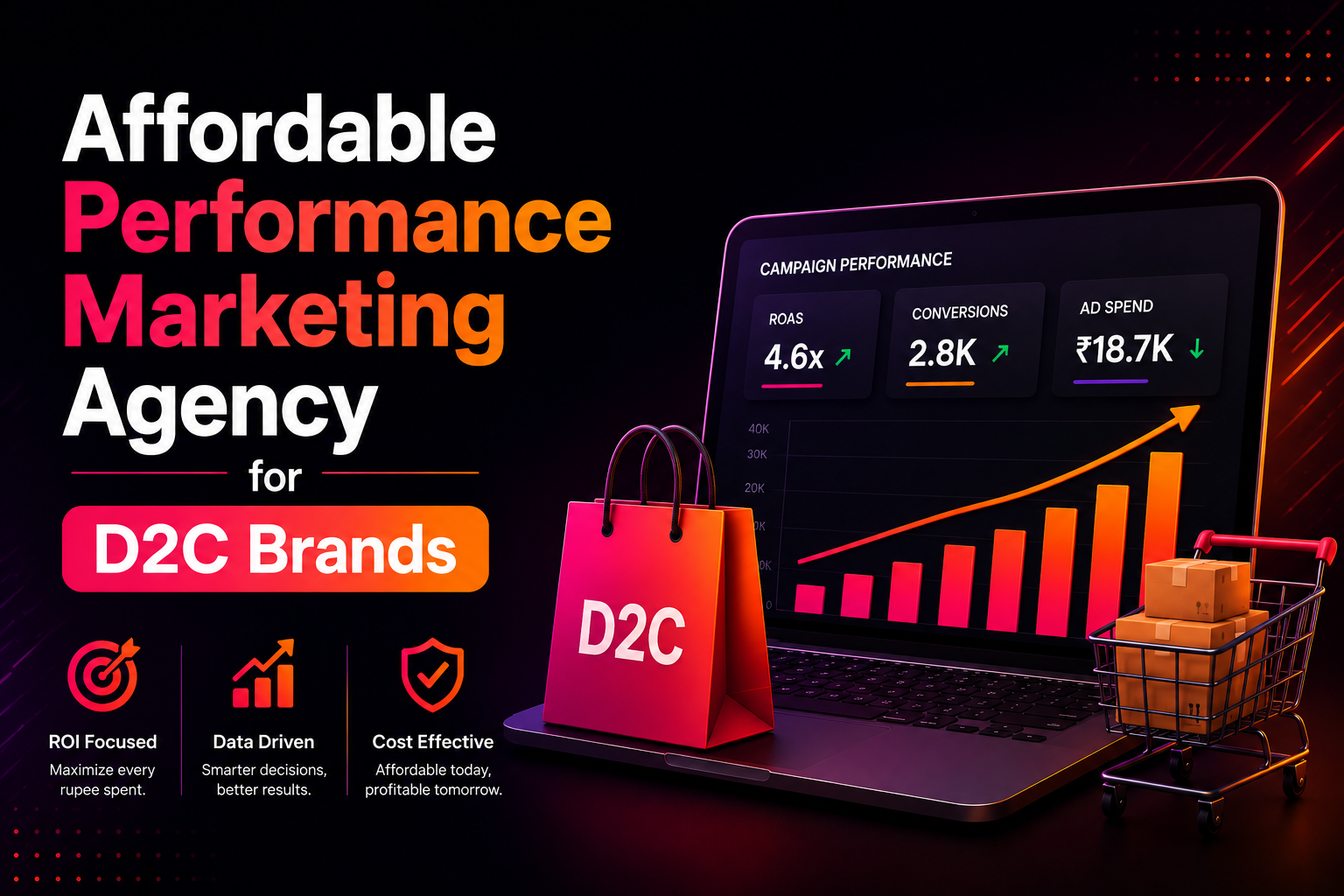
If you run a D2C brand, you have probably already tried boosting a post or two. Maybe you got some likes, a few comments, even a handful of orders — but nothing that felt like a real, repeatable system for growth.
If you run a D2C brand, you have probably already tried boosting a post or two. Maybe you got some likes, a few comments, even a handful of orders — but nothing that felt like a real, repeatable system for growth.
That gap between "spending money on ads" and "actually growing the business" is exactly where an affordable performance marketing agency for D2C brands is supposed to step in. But the word "affordable" gets thrown around so loosely that it's worth asking what it really means, and how to tell a genuinely cost-effective partner from one that's simply cheap.
Performance marketing is often confused with just "running ads," but the two aren't the same. Traditional advertising is about visibility — getting your brand in front of as many eyes as possible. Performance marketing is about outcomes: every rupee spent is tied to a measurable action, whether that's a click, a lead, or a sale. If a campaign isn't producing results, it gets changed or rebuilt, not left running on hope.
This distinction matters more for a D2C brand than for almost any other business model. There's no physical store pulling in walk-in customers, no distributor pushing your product onto shelves. Every customer has to be found, convinced, and converted online — which makes performance marketing less of a nice-to-have and more the actual engine that drives revenue.
There's a common assumption that low-cost digital marketing agencies cut corners, while expensive ones automatically deliver better results. In reality, cost and effectiveness aren't directly linked. What separates a genuinely affordable performance marketing agency from an ineffective one isn't the price tag — it's how the budget is structured and where it actually goes.
A well-run, budget-friendly agency does three things well. It builds a strategy matching your budget, instead of trying to run five channels at once on a two-channel budget. It's transparent about how much of your spend goes into ad platforms versus its own fee, so you know exactly what you're paying for. And it reports results in a way you can actually understand, instead of burying you in metrics that sound impressive but don't tell you whether you made or lost money.
Be cautious of agencies that promise guaranteed results before understanding your product, hide their reporting behind vague dashboards, or push the most expensive package regardless of what your business actually needs at its current stage.
One of the biggest sources of confusion for D2C founders is not separating two different costs: the agency's management fee and the actual ad spend going to platforms like Meta and Google. These are separate pools of money, and a good agency will always break this out clearly.
In the Indian market, budget-conscious performance marketing engagements typically pair a modest monthly ad spend with a management fee that scales with the account's size and complexity. The exact numbers vary by category and competition, but the principle stays the same: an affordable agency prices in tiers, so a brand just starting to scale online isn't paying for the same scope of work as an established brand running campaigns across five markets. That's very different from how many enterprise-focused agencies operate, where minimum retainers alone can price out a smaller D2C business before the conversation even starts.
A few signals separate the agencies worth talking to from the ones worth skipping. Look for a track record with brands that were once at a stage similar to yours, not just logos of massive companies with massive budgets — the strategy for a growing brand looks nothing like the strategy for an established one. Ask them to walk you through a sample report before signing anything; if they can't explain it simply, that's a red flag. Pay attention to how they talk about your product in the first conversation — an agency asking real questions about your margins and your customer is thinking about your business, not just your ad account. And notice how easy they are to reach day-to-day. For most growing D2C founders, quick, direct communication matters just as much as the strategy itself.
A good budget-friendly partner doesn't start by launching ads. It starts by auditing where your current spend, if any, is actually going and where it's leaking. From there, it picks the one or two channels that make the most sense for your budget and product, instead of spreading a small budget thin across Meta, Google, and SEO at once — one of the most common reasons D2C founders feel like digital marketing "doesn't work" for them.
Once a channel is chosen, the focus shifts to execution: sharper targeting, creative that actually speaks to your specific customer, and landing pages built to convert. Reporting then happens on a predictable schedule, in language that connects ad performance back to actual sales and ROI, not just clicks. As results come in, budget gets reinvested into what's working and pulled back from what isn't. Repeated consistently, this is what "scaling" actually looks like in practice — very different from the trial-and-error most brands try on their own before finding a partner.
Most agencies will tell you they're "data-driven" and "results-focused." Almost none will show you what that actually means before you sign a contract. This is usually where budget-conscious D2C founders get burned — not because performance marketing fails, but because the agency running it never had a plan sized to the budget in the first place.
At Devout Growth, every D2C account starts the same way: understand the margin, understand the customer, and understand what the budget can realistically achieve before a single ad goes live. That sounds obvious, but it's the step most low-cost agencies skip in a rush to start spending. A brand with a modest monthly budget doesn't need five channels running at once — it needs one or two run properly, with creative and targeting sharp enough to make every rupee count. That's the reason smaller D2C brands are able to work alongside considerably larger accounts here, without their budget getting deprioritised.
Reporting follows the same logic. Instead of dashboards full of impressions and reach numbers that sound good but say nothing about revenue, reporting focuses on what actually moved — cost per lead, cost per acquisition, and how that compares to the previous cycle. Founders don't need a marketing background to read these reports; the numbers are built to answer one question directly: is this working or not.
There's also a practical edge to working with a team running campaigns across genuinely different budget sizes and industries in the same year. The strategy suggested for your brand isn't a scaled-down enterprise playbook — it's built for exactly the stage you're at, with a clear path for what changes as the budget grows. One recent public-sector engagement is a good example of this discipline in action: brought in to build visibility from close to zero, the account nearly doubled its reach within eleven months, using the same sequence outlined in this article — fix what's broken, focus the strategy, execute with discipline, measure against the outcome that actually mattered. Different sector, same process.
For a D2C founder comparing agencies, the real question isn't which one has the flashiest client logos. It's the one that can explain, in plain language, exactly what they'll do with your specific budget and how they'll know if it's working. That's the conversation Devout Growth has with every D2C brand before any campaign starts, not after. If you want to know the right strategy for your D2C brand, you can book our free consultation today.
No. Performance marketing scales with budget. A smaller budget simply means a more focused strategy — usually one or two channels done well, rather than several done poorly.
Early signals, such as engagement and initial conversions, typically show up within the first few weeks. Meaningful, consistent results usually take a couple of months, since campaigns need time and data to optimise properly.
Boosting a post increases visibility with minimal targeting or optimisation. Performance marketing involves structured targeting, testing, conversion tracking, and ongoing optimisation based on actual business outcomes, not just engagement.
Yes, and this is usually the smarter approach. Starting with a smaller, well-targeted budget lets you validate what works before committing more spend to it.
Ask for reporting that ties directly back to revenue and cost per acquisition, not just impressions, reach, or engagement numbers. If an agency cannot show you this connection clearly, that is worth questioning.
 August 10, 2026
 August 2, 2026
 May 5, 2026