- Shivam Pandey
- May 05, 2026
You boosted a post on Facebook. Got 200 likes, a handful of comments — and zero customers. Sound familiar?
You boosted a post on Facebook. Got 200 likes, a handful of comments — and zero customers. Sound familiar?
if you are a small or mid-sized business owner in India, chances are you have been there. Maybe you are running a manufacturing unit in delhi, a retail shop in Pune, or a service business in Lucknow. You have been told "go digital" — but nobody told you which digital, how much to spend, or what to expect in return.
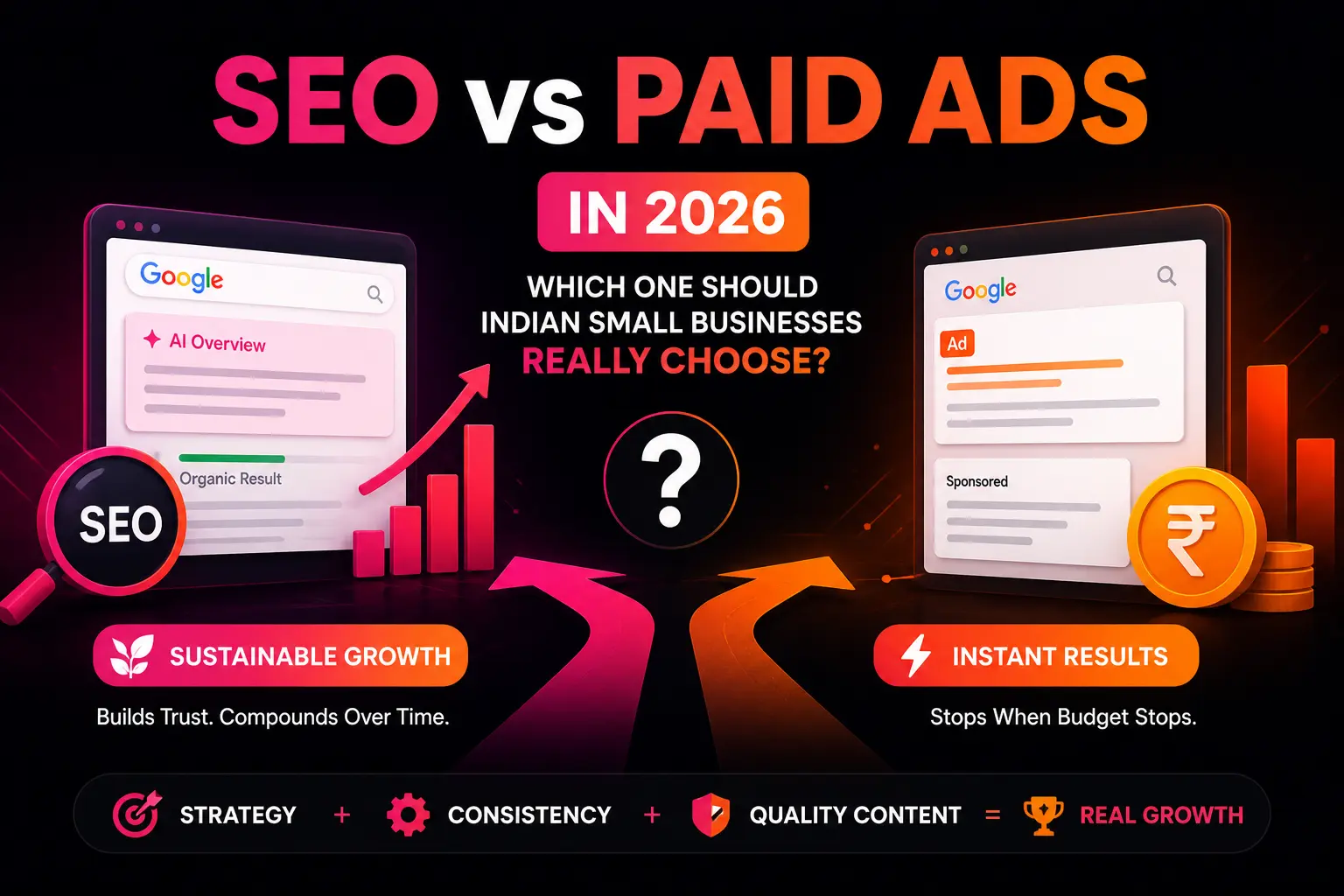
The two biggest options in front of you are SEO and Paid Ads. Both promise growth. Both have their fans. And most articles on the internet will tell you to "use both" without giving you a straight answer.
This article will. Let's break it down — plainly, honestly, and with numbers that actually matter to Indian businesses in 2026.
Before comparing them, let's strip away the jargon.
SEO (Search Engine Optimisation) is the process of getting your website to appear organically — that means for free — on Google's first page when someone searches for your product or service. If someone in Delhi types "best packaging supplier near me" and your business shows up without you paying for that click, that is SEO doing its job.
Paid Ads (Google Ads, Meta Ads, etc.) is exactly what it sounds like — you pay to appear at the top of search results or social media feeds. You set a budget, define your audience, and your business shows up instantly. The moment you stop paying, though, you disappear just as instantly.
Think of it this way: Paid Ads is renting a shop in a prime mall. SEO is owning property on a busy street. Both get footfall — but one costs you every single month, and the other builds long-term equity.
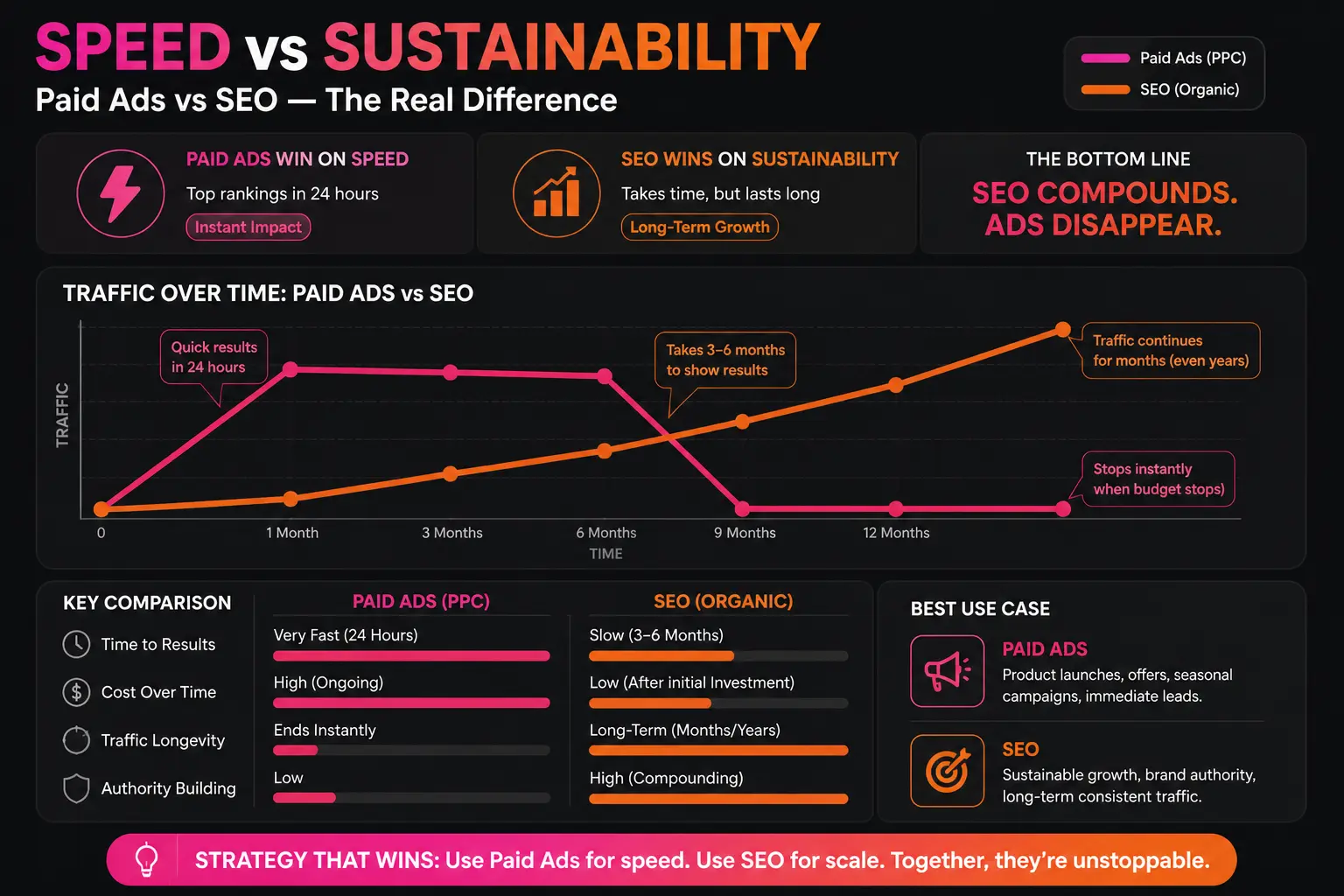
This is the heart of the entire debate, and it is worth being direct about it.
Paid Ads win on speed — and it is not even close. A well-set-up Google Ads campaign can have your business appearing at the top of search results within 24 hours of going live. For a business launch, a Diwali sale, or a seasonal push, that speed is genuinely irreplaceable. There is no organic shortcut that gets you there faster.
SEO, on the other hand, is a 3-to-6-month minimum commitment before meaningful results appear. For new websites targeting competitive keywords in Indian metro markets, ranking on Page 1 can take 8 to 12 months. This is not a flaw — it is simply the time required to build genuine authority with Google.
But here is what most people miss: SEO compounds. Paid Ads do not.
A blog post or service page that reaches Page 1 for a high-intent keyword will keep generating clicks for months — sometimes years — without additional investment. Paid Ads? The moment the budget stops, the traffic stops. Same day. No residual.
India's digital advertising market is projected to cross ₹70,000 crore in 2026, making it one of the fastest-growing digital economies in Asia. Yet a significant portion of that spend is being wasted on the wrong channel, at the wrong time, for the wrong stage of business.
Here are the numbers that matter specifically for Indian small and medium businesses:
For a mid-size manufacturer or retailer in Tier-2 India, the maths often favours SEO significantly over a 12 to 24-month horizon — but only if the business can survive the waiting period. That is the honest trade-off.
Paid Ads are not the villain in this story. In fact, there are very clear situations where they are the only sensible choice.
If your sales pipeline is dry and you need revenue in the next 30 days, SEO simply cannot help you in time. Paid Ads are your only realistic option. Start a targeted Google Ads or Meta Ads campaign, define your audience precisely, and you can be generating inquiries within 48 hours.
A new product line, a new business location, a festival offer — Paid Ads give you instant visibility that no amount of SEO preparation can replicate on a tight timeline. Use them to announce, attract, and convert during time-sensitive windows.
Running a paid campaign on a set of keywords is one of the most efficient ways to validate whether a market exists before committing to a 6-month SEO strategy. If a keyword converts well at paid prices, it will almost certainly deliver strong ROI through organic ranking too. Use Paid Ads as a research tool, not just a traffic tool.
If you are selling industrial equipment, real estate, or premium services where a single customer is worth ₹1 lakh or more, you can absorb the higher cost-per-click and still be profitable. The economics work in your favour even with expensive clicks.
The key rule to remember: Paid Ads deliver traffic on demand. But that demand must be funded continuously.
SEO is the right primary strategy when:
If you run a manufacturing unit, a service business, or any B2B company where buyers research extensively before purchasing, SEO ensures you are present at every stage of that research journey — without paying for every single click.
If you cannot sustain ₹30,000 to ₹50,000 per month in ongoing ad spend, burning through that budget on clicks is a dangerous game. SEO builds a digital asset. Paid Ads do not. A well-optimised website page can bring in leads for years. A paused ad campaign brings in nothing from the moment it stops.
Studies consistently show that users trust organic search results significantly more than paid advertisements. For a small business trying to establish credibility against larger competitors, ranking organically on Google sends a powerful trust signal that no amount of ad spend can fully replicate.
Local SEO — optimising your Google Business Profile, getting listed on JustDial and Sulekha, building consistent NAP (Name, Address, Phone) presence across directories, and collecting Google reviews — is one of the highest-ROI investments available to any Indian small business targeting customers within a specific city or district. It is also significantly cheaper than running paid campaigns for the same local audience.
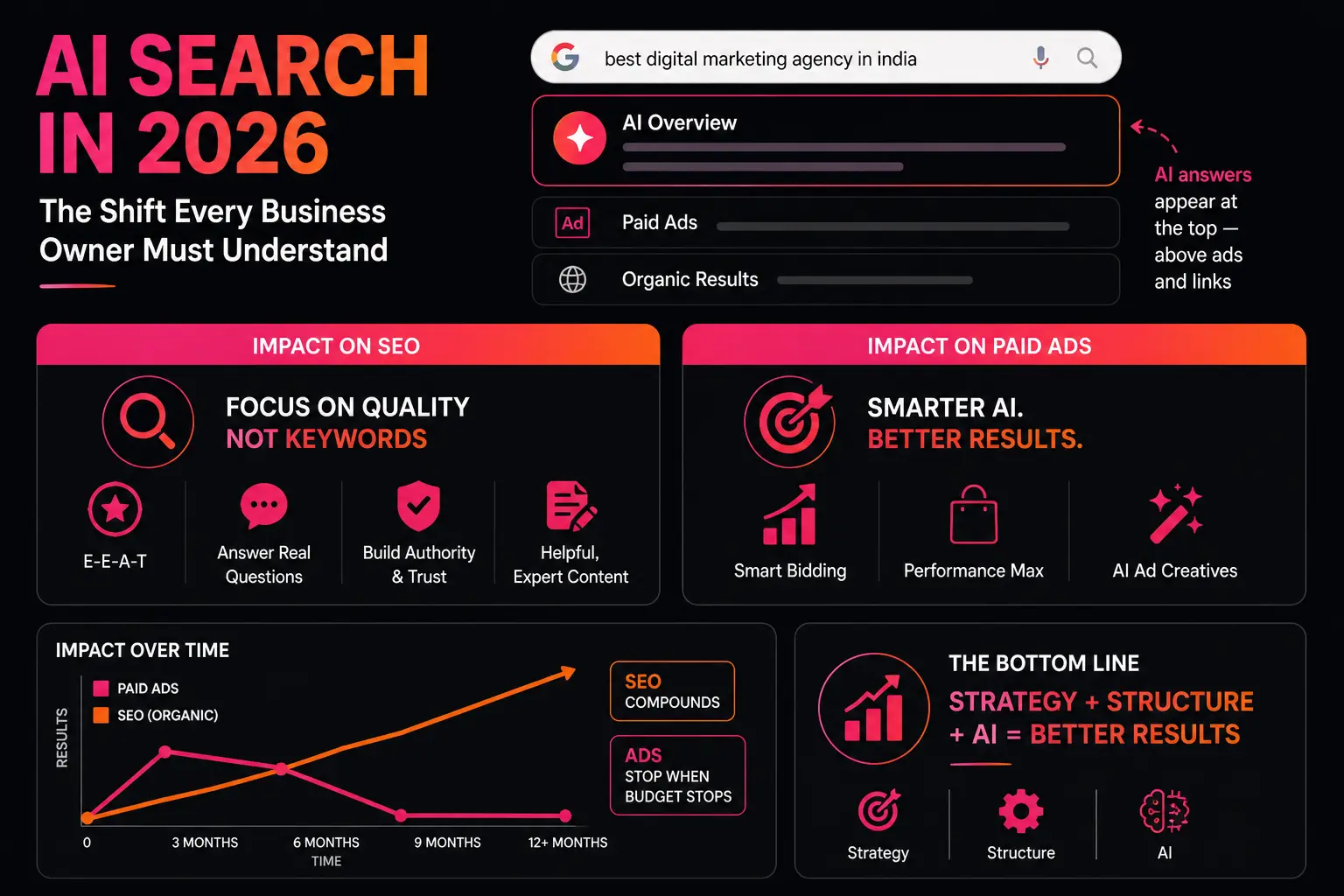
When someone searches "best digital marketing agency in india" or "how to generate leads for a manufacturing business," Google's AI now often surfaces a direct answer at the very top of the page — above both ads and organic links. This is a fundamental change to how search works, and it affects both SEO and Paid Ads strategies.
What this means for SEO: Your content must go beyond keywords. Google's AI pulls answers from pages that demonstrate Experience, Expertise, Authority, and Trustworthiness (E-E-A-T). You need content that genuinely answers real questions your customers are asking — not pages stuffed with keywords for the sake of it. Thin, generic content no longer ranks. Helpful, specific, and expert content does.
What this means for Paid Ads: AI-powered targeting on Google and Meta is now more precise and automated than ever. Smart Bidding, Performance Max campaigns, and AI-generated ad creatives mean that even modest budgets can be deployed with greater efficiency — but only if your campaigns are structured correctly. Random boosted posts and unstructured ad accounts are even less effective in 2026 than they were in 2023.
The bottom line: Both SEO and Paid Ads require more strategic thinking in 2026 than they did two or three years ago. Boosting a Facebook post with no targeting or throwing money at Google without keyword research is how marketing budgets get wasted — and that is exactly why so many small business owners feel digital marketing does not work for them.
Here is the answer that most successful Indian business owners eventually arrive at after trying one channel in isolation: use both — but in the right sequence, not simultaneously from day one.
Here is what a practical roadmap looks like for a small business owner with a ₹25,000 to ₹50,000 per month marketing budget:
Months 1 to 3 — Build and Test with Paid Ads Run targeted Paid Ads to generate immediate leads. Use this period to identify which keywords, audiences, and offers actually convert for your business. Simultaneously, begin foundational SEO work — website optimisation, Google Business Profile setup, and initial content creation. Do not wait for one to finish before starting the other.
Months 4 to 9 — SEO Gains Momentum As SEO starts gaining traction, organic leads begin supplementing your paid campaigns. Your overall cost-per-lead starts dropping. Continue both channels in parallel. The data from your paid campaigns directly informs your SEO content strategy — you already know what converts.
Months 10 to 18 — Shift the Balance SEO is now delivering consistent organic traffic for your core keywords. Gradually reduce paid spend on keywords where you now rank organically, and redirect that budget toward new markets, new products, or retargeting campaigns for warm audiences.
The result: your competitor is paying ₹300 per click in perpetuity for a keyword. You have built an organic ranking for that same keyword and now pay ₹0 per click. Over 24 months, that difference is enormous — both in cost savings and in competitive advantage.
| Your Situation | Best Starting Channel |
| Need leads within the next 30 days | Paid Ads |
| Monthly marketing budget under ₹20,000 | SEO first |
| Selling high-ticket products or services (₹50,000+) | Both; start with Paid Ads |
| Building a business for the next 3 to 5 years | Prioritise SEO alongside Paid Ads |
| Tried ads before with zero results | Fix your funnel and landing page first, then re-run |
| Already getting some organic traffic | Double down on SEO |
SEO and Paid Ads are not rivals. They are tools — and like every tool, their value depends entirely on how and when you use them.
For Indian small business owners facing increased competition, shrinking margins, and a customer base that now starts every purchase decision on Google, the question is not "SEO or Paid Ads?" The real question is: "What stage is my business at, and what does it need right now?"
If you need leads this month, invest in Paid Ads. If you want to build a business that does not depend on a continuous advertising budget to stay visible, invest in SEO. And if you want to build something that compounds and scales over time — combine both, in the right sequence, with a clear strategy behind every rupee you spend.
Digital marketing is not complicated when someone explains it honestly. Now that it has been — the next move is yours.
Have questions about which strategy fits your specific business? Write to contact@devoutgrowth.com We will help you build a plan that fits your budget and growth goals.
No FAQs available for this blog post.