- Raj Divya
- August 02, 2026
Growing from one dental clinic to multiple locations is a big achievement. But when it comes to search visibility, adding more branches doesn't automatically mean you'll attract more patients.
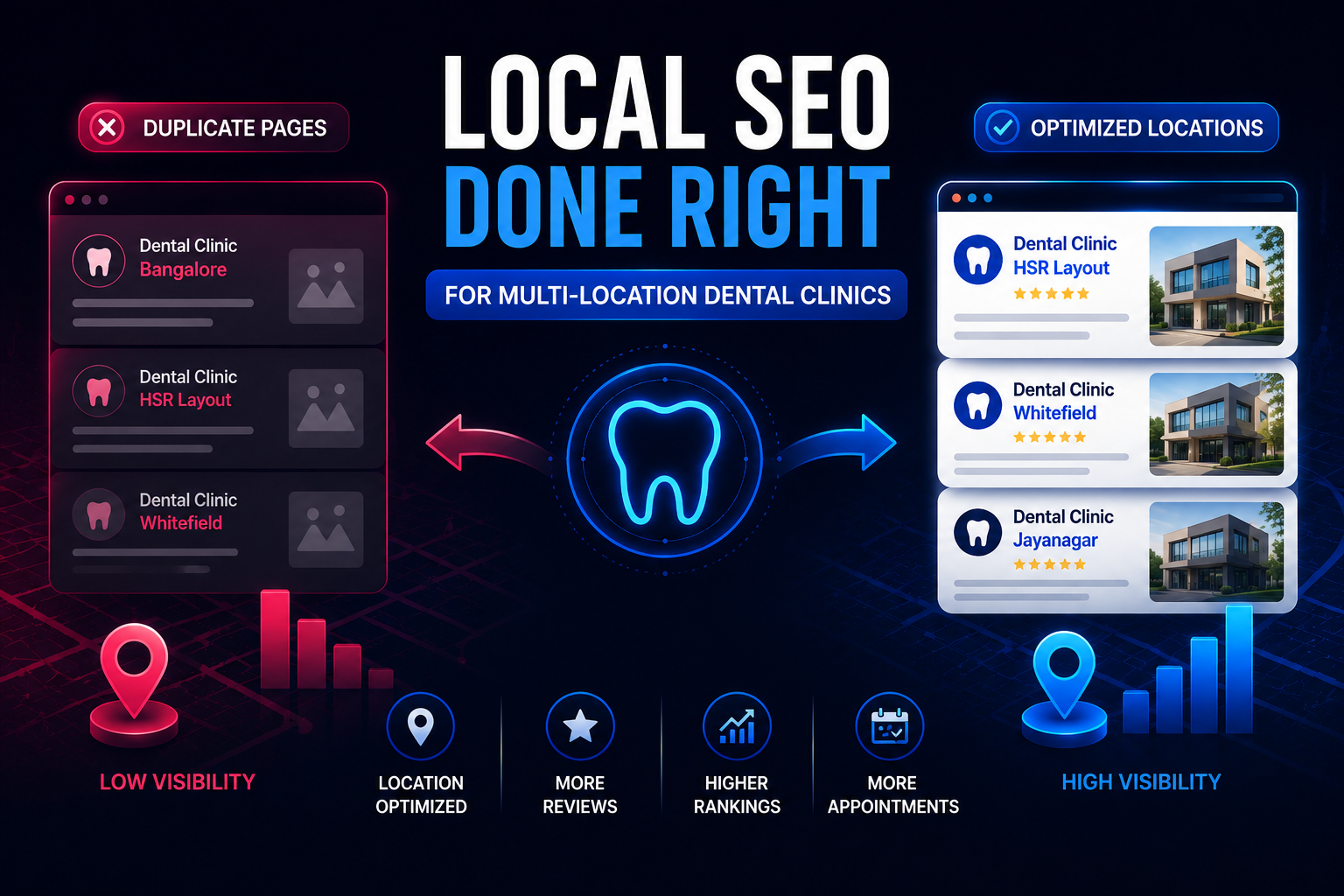
Growing from one dental clinic to multiple locations is a big achievement. But when it comes to search visibility, adding more branches doesn't automatically mean you'll attract more patients.
Many dental groups notice something surprising after expansion. One clinic ranks consistently on Google, receives appointment enquiries, and stays visible in local search. Another branch, despite offering the same treatments under the same brand, barely appears in search results.
The issue usually isn't the quality of care—it's the SEO strategy.
Local SEO for multi-location dental clinics isn't about duplicating one successful page and replacing the city name. Every clinic serves a different audience, competes with different local practices, and sends unique signals to Google.
If you want every branch to become the first choice in its neighbourhood, you need a location-page framework that gives each clinic its own identity while keeping your brand consistent. That's exactly what this guide will help you build.
A single-location clinic focuses on building authority for one address and one service area.
A multi-location practice has a much bigger challenge.
Every clinic has to earn visibility independently without competing with another branch under the same brand. Google doesn't rank your dental group as one business. It evaluates each clinic based on its own relevance, trust, and local authority.
That's why multi-location dental SEO requires a different strategy altogether.
Each branch needs its own:
When these signals are missing or duplicated across locations, rankings often suffer.
One of the biggest misconceptions among growing dental brands is assuming Google automatically understands the relationship between all their clinics.
It doesn't.
To Google, every clinic is its own local business.
Even if two branches share the same logo, website, and treatments, Google still evaluates them separately based on factors like:
For example, someone searching for "Dental Implants in Whitefield" expects results specifically related to Whitefield—not another branch located across the city.
This is why every location should have unique information instead of relying on a generic website page.
A strong local SEO for dental practices strategy ensures every clinic builds authority within its own service area.
It's common to see one clinic performing exceptionally well while another branch barely ranks.
The difference usually comes down to local optimisation.
One clinic may have:
Meanwhile, another location may have copied website content, outdated business details, and very little local engagement.
Google notices these differences.
That's why dental SEO for multiple locations focuses on improving every clinic individually rather than assuming the strength of one location will automatically benefit the others.
Many dental groups invest in SEO but still struggle to improve local rankings because of a few avoidable mistakes. In most cases, the problem isn't a lack of effort—it's following a strategy that works for a single clinic but not for multiple locations.
Here are some of the most common mistakes to avoid:
Even small inconsistencies can confuse Google and make it harder for the right clinic to appear in local search results. A strong local SEO strategy for dental clinics focuses on keeping every location accurate, relevant, and active.
Managing SEO becomes more complicated as your practice grows. Updating multiple location pages, maintaining Google Business Profiles, tracking rankings, and responding to reviews can quickly become difficult for an in-house team.
You should consider professional local SEO services for dental clinics if:
An experienced agency doesn't just improve rankings—it creates a structured plan that helps every location build authority in its own market while supporting your overall brand.
SEO isn't a one-time setup. It's an ongoing process that requires continuous optimisation.
A typical dental practice SEO package may include:
The exact investment depends on the number of clinics, competition in your target areas, and the current condition of your website.
Rather than looking for the cheapest option, focus on building a strategy that delivers consistent visibility and patient enquiries over time.
Not every dental group has the budget to optimise every location at once, and that's perfectly fine.
Start with the improvements that create the biggest impact.
Prioritise these areas first:
1. Create unique dental location pages for every clinic.
2. Optimise each Google Business Profile for multiple locations.
3. Keep NAP information consistent everywhere online.
4. Collect genuine patient reviews regularly.
5. Add location-specific content instead of duplicate pages.
Once these fundamentals are in place, you can gradually invest in backlink building, content marketing, and advanced local SEO initiatives.
Getting the basics right often produces better results than trying to do everything at once.
This isn't really an either-or decision.
Paid ads can help you generate enquiries quickly, especially for new clinic launches or high-value treatments. However, the moment you stop spending, visibility disappears.
Local SEO for multi-location dental clinics works differently.
It takes time to build authority, but once your location pages and Google Business Profiles start ranking, they continue bringing in qualified local traffic without paying for every click.
The most successful dental groups usually combine both strategies.
Paid search supports immediate lead generation, while multi-location SEO builds long-term visibility and trust. Together, they create a balanced marketing approach that supports both short-term growth and sustainable patient acquisition.
Expanding your dental practice into multiple locations is a major milestone, but every new clinic also brings a new SEO challenge.
Google doesn't rank your brand as a whole. It ranks each location based on how relevant, trustworthy, and helpful it is for local patients.
That's why successful local SEO for multi-location dental clinics starts with treating every branch as its own local business. From creating unique dental location pages to maintaining accurate business information and optimising every Google Business Profile for multiple locations, every detail contributes to stronger local visibility.
A well-planned local SEO strategy for dental clinics doesn't just improve rankings—it helps the right patients find the right clinic at the right time. And that's what ultimately drives more appointments, stronger local trust, and long-term growth for your practice.
Because every clinic has its own location, competitors, and search audience. Each branch needs individual optimisation to rank well in local search results.
Yes. Every location should have its own Google Business Profile for multiple locations with accurate business information, reviews, and photos.
A complete location page should include clinic details, services, dentist profiles, Google Maps, patient reviews, FAQs, contact information, and a clear appointment CTA.
Most clinics begin seeing noticeable improvements within three to six months, depending on competition, website health, and the consistency of SEO efforts.
Yes, but each location page should target its own local area with unique content to avoid keyword cannibalisation.
Absolutely. A well-executed local SEO strategy helps every clinic improve visibility, attract qualified local patients, and generate sustainable appointment enquiries without relying only on paid advertising.